Background
Traditional Discrete Fourier Transform (DFT) faces complexity limits with massive data. Quantum Fourier Transform (QFT) leverages quantum superposition to perform frequency mapping in logarithmic time, redefining the logic of signal analysis.
Core Theory
1. Quantum Fourier Transform (QFT)
$|j\rangle \to \frac{1}{\sqrt{N}} \sum_{k=0}^{N-1} e^{2\pi i j k / N} |k\rangle$. QFT requires only $O(n^2) = O(\log^2 N)$ gates, an exponential speedup over classical FFT.
2. Quantum Phase Estimation (QPE)
Used to extract the phase of an operator’s eigenvalue into auxiliary registers, enabling precise identification of harmonics.
3. Sampling & Amplitude Amplification
Quantum state preparation maps signals to amplitudes, allowing Grover-like algorithms to detect spectral features with $O(\sqrt{N})$ efficiency.
Figure
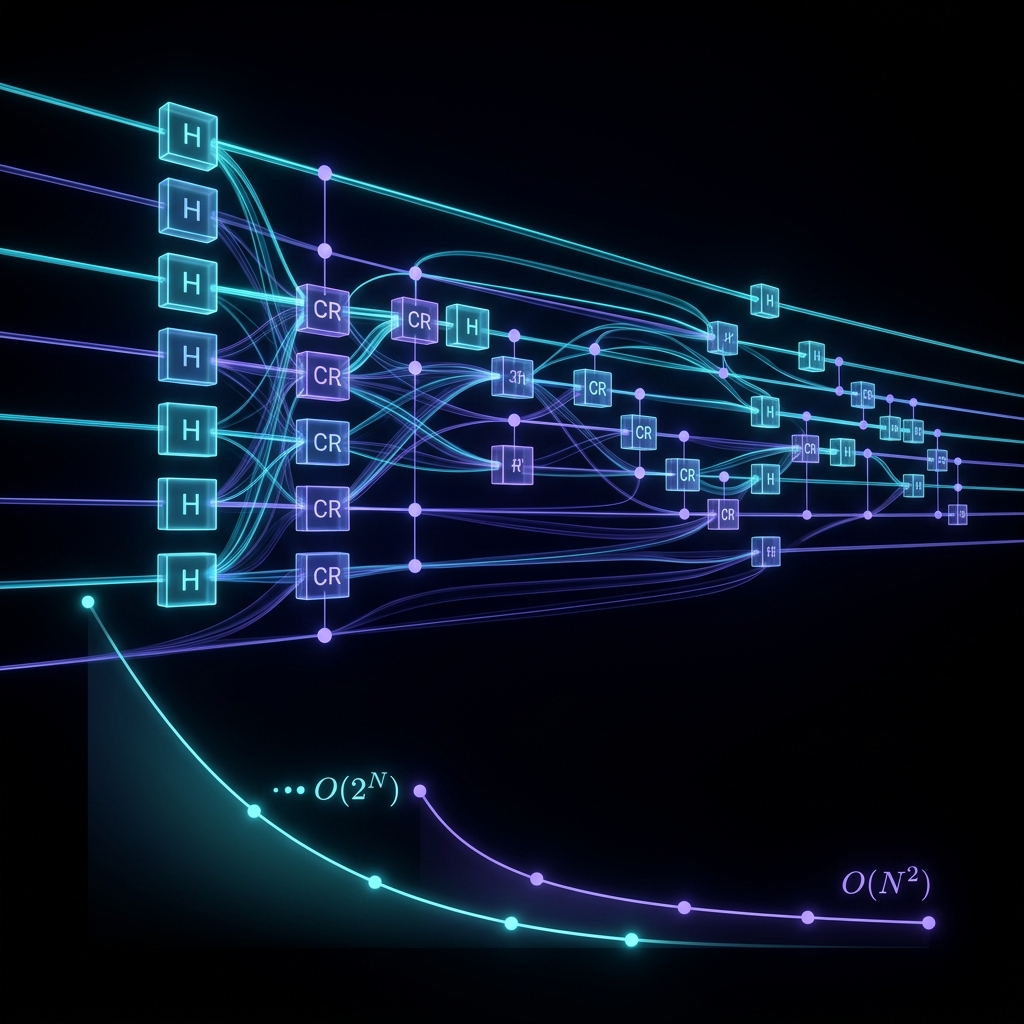 Figure 1: Illustration of QFT circuit complexity compared to classical FFT on a logarithmic scale.