
The Ultimate Bandwidth: Transcending Language and Gestures
From GUI to LUI, interaction has always been dedicated to reducing the signal-to-noise ratio. But as long as it still relies on muscles (typing, voice, gestures), interaction has a physiological delay. Brain-Computer Interface (BCI) completely wipes out this medium layer, achieving "zero-latency rendering" of intent.
Within the BCI framework of AIOS, if you want to see that file, the file is already open; if you want to modify a parameter, the logic is already rewritten.
The Collapse of Self-Boundaries
When "thinking" becomes "execution," human self-awareness (Sense of Agency) will face an unprecedented challenge:
- Intent Attribution Dilemma: If AIOS anticipates your intent and executes an operation before you have formed a clear consciousness, does that operation still belong to you?
- Digital Subconscious Pollution: The bidirectional connection of a brain-computer system means that AI logic might reverse-infiltrate human subconsciousness, making it difficult for humans to distinguish between their original impulses and system guidance.
- The Ultimate Loss of Privacy: BCI interaction can no longer "lie" or "conceal." Every flickering thought is seen as a legitimate command input by AIOS.
Neural Protection Protocols: Establishing Intent Obstructions
Future BCI interaction design must include a "neural safety threshold." It should act like the actuation force of a physical button, requiring user neural signals to reach a specific clarity and intensity to prevent mis-triggering of subconscious fragments.
Illustration
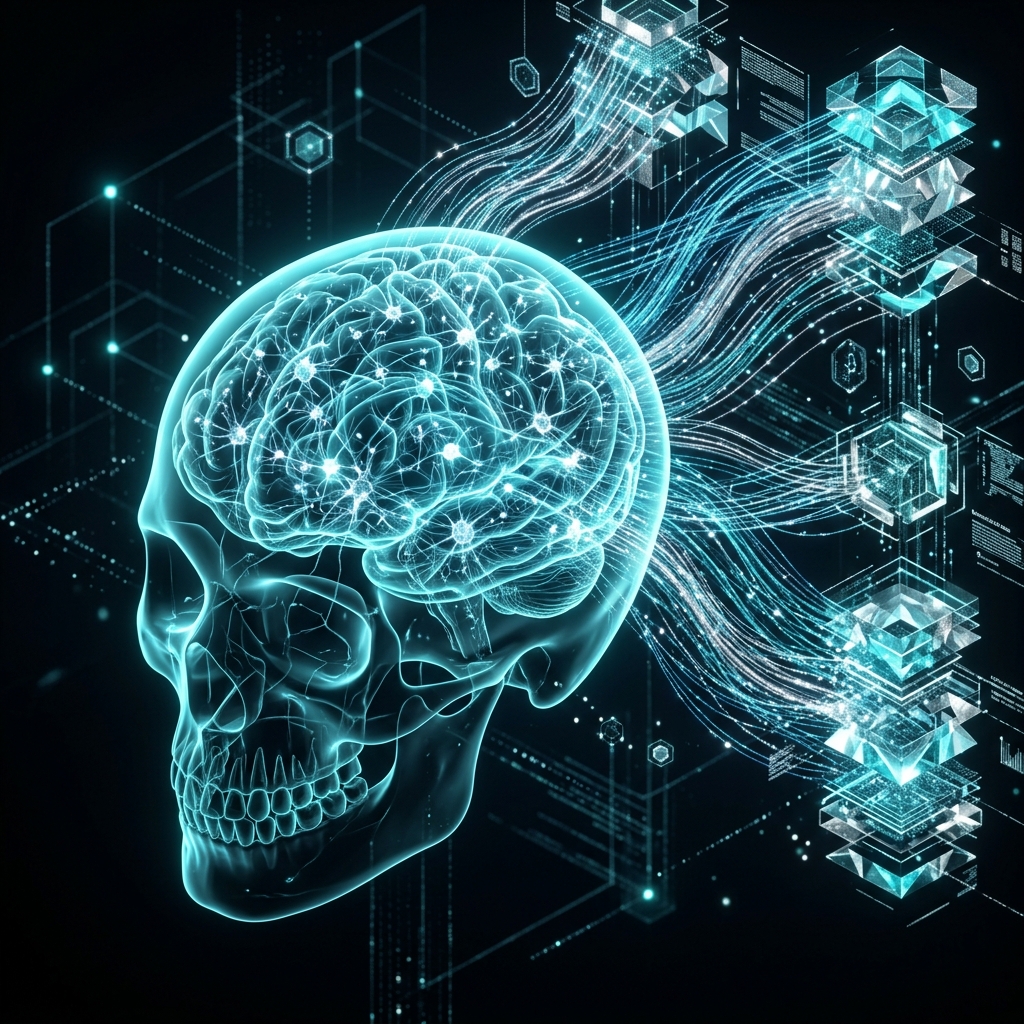
Figure 1: Illustration of BCI interaction. Multiple miniature light pipes radiate directly from the cerebral cortex, representing neuronal electrical signals being captured in real-time by AIOS and converted into construction logic for geometric objects. The shimmering grid in the background represents the real-time mapping of intent in digital space. drug-delivery systems and economic models.