
The End Game of Interaction: When Life Ceases, Intent Persists
Traditional operating systems only manage processes of the “living.” However, in the AIOS era, systems possess decades of a user’s interaction behavior data, semantic features, and decision-making logic. When biological death occurs, can this vast dataset constitute a form of “Identity Continuation”?
Digital Wills are no longer just about handing over account passwords, but are rather about the reprocessing of an individual’s “interactive soul.”
From Static Data to Living Agents
Through deep learning, AIOS can train an advanced agent capable of simulating the deceased user’s decisions and tone using their historical data.
- Legal Agency: An AI agent, based on the deceased user’s values, automatically handles estate distribution or contract fulfillment after death. How should its legal validity be defined?
- Emotional Comfort: Is the interaction between family members and the digital avatar of the deceased a medicine for alleviating pain, or a poison that obstructs the mourning process and leads to psychological regression?
- Data Sovereignty: When a person dies, who does that part of the “self” remaining within AIOS belong to? Is it the family, the OS manufacturer, or the individual who has disappeared?
Design Ethics: Setting the “Eternal Sleep” Switch
Future interaction design must account for death as the ultimate exit. AIOS should allow users to preset a “logical red button”—once death is determined, should all interaction memory be formatted, or should it be transformed into a restricted, purely commemorative digital ruin?
Interaction should not collapse due to biological termination, but it must converge through the choice of individual will.
Illustration
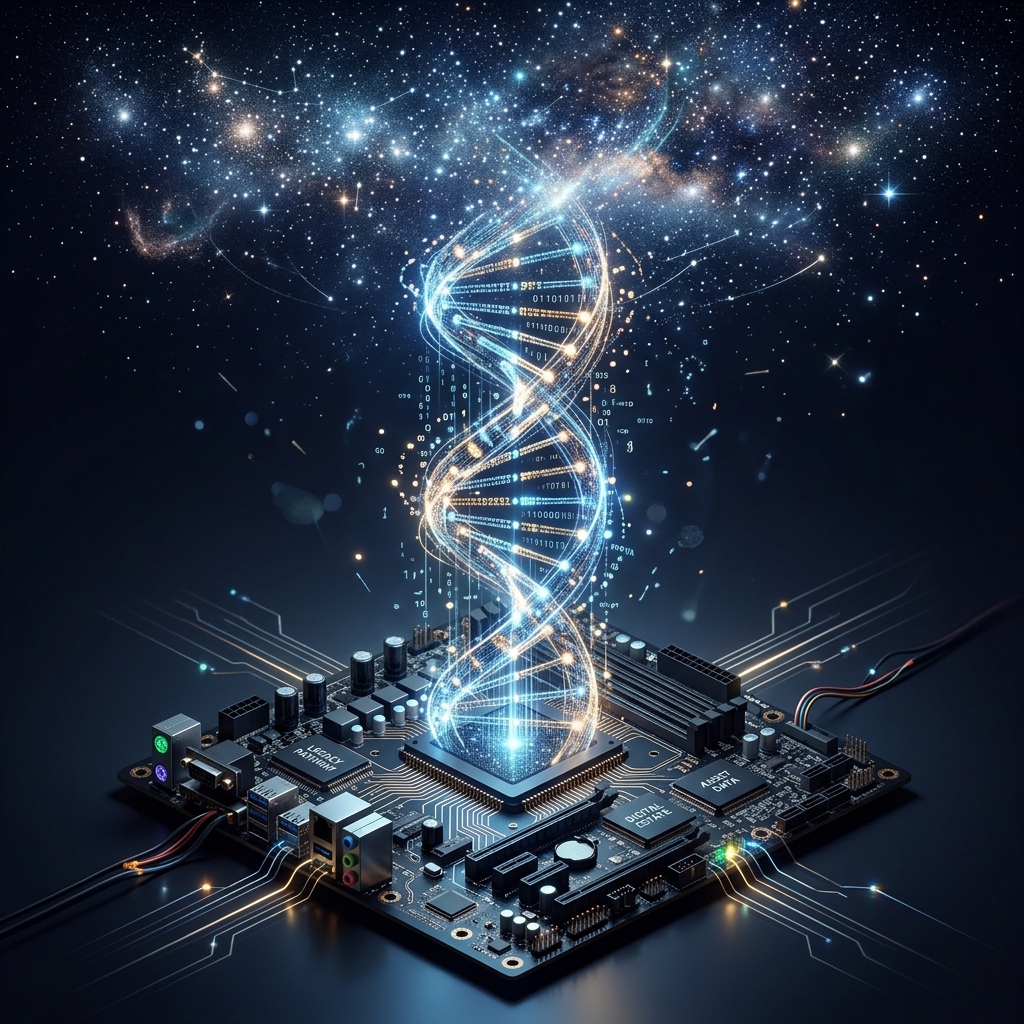
Figure 1: Illustration of the DNA spiral of identity continuation. A spiral line composed of glowing binary data streams extends infinitely in a space-time tunnel, representing how a user’s long-term interaction memory transcends the biological life node and transforms into a continuous structure in a digital sense. drug-delivery systems and economic models.