
Aura Dual-Core Architecture: Deep Decoupling of Meta Commander and Matrix Executor
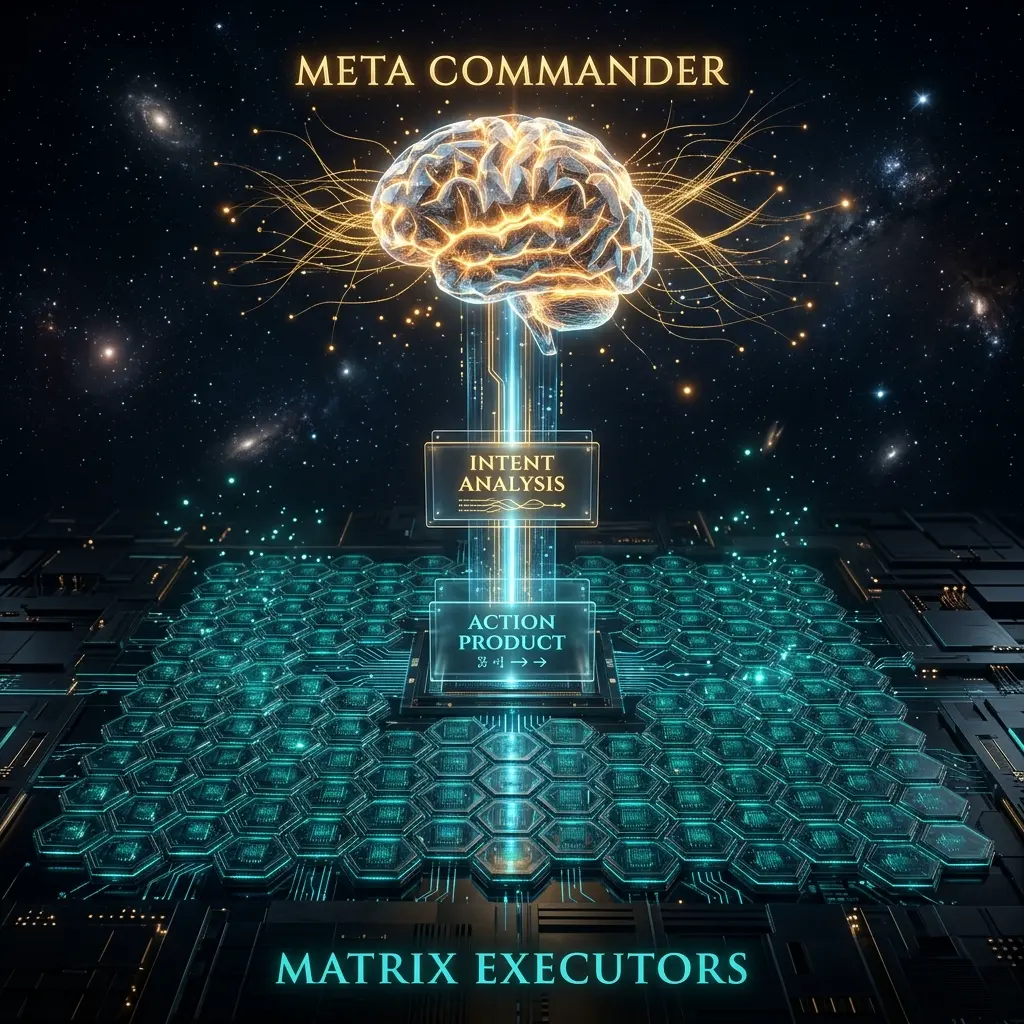
In traditional AI Agent paradigms, we often expect a single Large Language Model (LLM) to act as both the “planner” and the “executor.” However, when handling complex engineering tasks, this coupling leads to severe cognitive overload: while the model thinks about how to call an API, it often loses track of the original task objective.
Aura rewrites these rules with its Meta/Matrix Dual-Core Architecture, introducing Master-Slave Control Logic from cybernetics to achieve physical-level decoupling of agent thinking and behavior.
1. Meta Kernel: Global Orchestration Based on Intent Entropy
The Meta kernel is the system’s “higher prefrontal cortex.” It holds no specific skills but operates through a set of protected Soul Rules.
1.1 Intent Deconstruction (S0)
When a user inputs a requirement, Meta’s first step is not execution, but Intent Entropy Analysis. It deconstructs vague natural language into a topology graph with deterministic boundaries. If the identified intent entropy is too high (semantic ambiguity), Meta triggers user interaction rather than making blind guesses.
1.2 Dynamic Planning (S1: Planning)
Meta utilizes Ant Colony Optimization (ACO) to search for optimal paths within a pre-defined 3D addressing space. Instead of code, it generates a sequence of 24-bit node pointers, acting as a precise “battle map” for the underlying Matrix.
2. Matrix Kernel: Passive Reaction and Atomic Execution
The Matrix kernel is designed as an absolute “controlled entity,” similar to a biological “spinal reflex center,” responsible for efficient, unbiased instruction execution.
2.1 Zero Autonomous Routing
In Aura, Matrix is stripped of the right to decide “what to do next.” It only receives address pointers from Meta and loads corresponding WASM plugins. This “thought stripping” design drastically reduces hallucination probability as Matrix no longer predicts the future, focusing solely on the current atomic task.
2.2 Product Isolation and Asynchronous Reporting
All Matrix execution products are pushed into an isolated Redis Stream. Meta obtains feedback by subscribing to this stream. This asynchronous mechanism allows Matrix to scale horizontally into thousands of independent instances for high-concurrency parallel processing.
3. Philosophy of Connection: State Alignment via ACP Protocol
The two kernels synchronize states via the ACP (Aura Communication Protocol):
- Forward Stimulation: Meta issues instruction streams.
- Negative Feedback: Matrix reports failure deviations, and Meta initiates Saga Compensation Logic based on those deviations.
This closed-loop feedback system mimics precision machinery control, ensuring the eventual consistency of complex long-range task execution through continuous “deviation correction.”
4. Conclusion: Freedom through Determinism
By separating Meta and Matrix, we solved an engineering dilemma: how to achieve industrial-grade execution stability without losing model flexibility. Meta looks at the stars (planning and evolution), while Matrix stays grounded (precise execution), together forming Aura’s powerful digital organism.
Produced by Dark Lattice Architecture Lab.