
Aura Curiosity Engine: Boundary Exploration Sampling via Beta Distribution
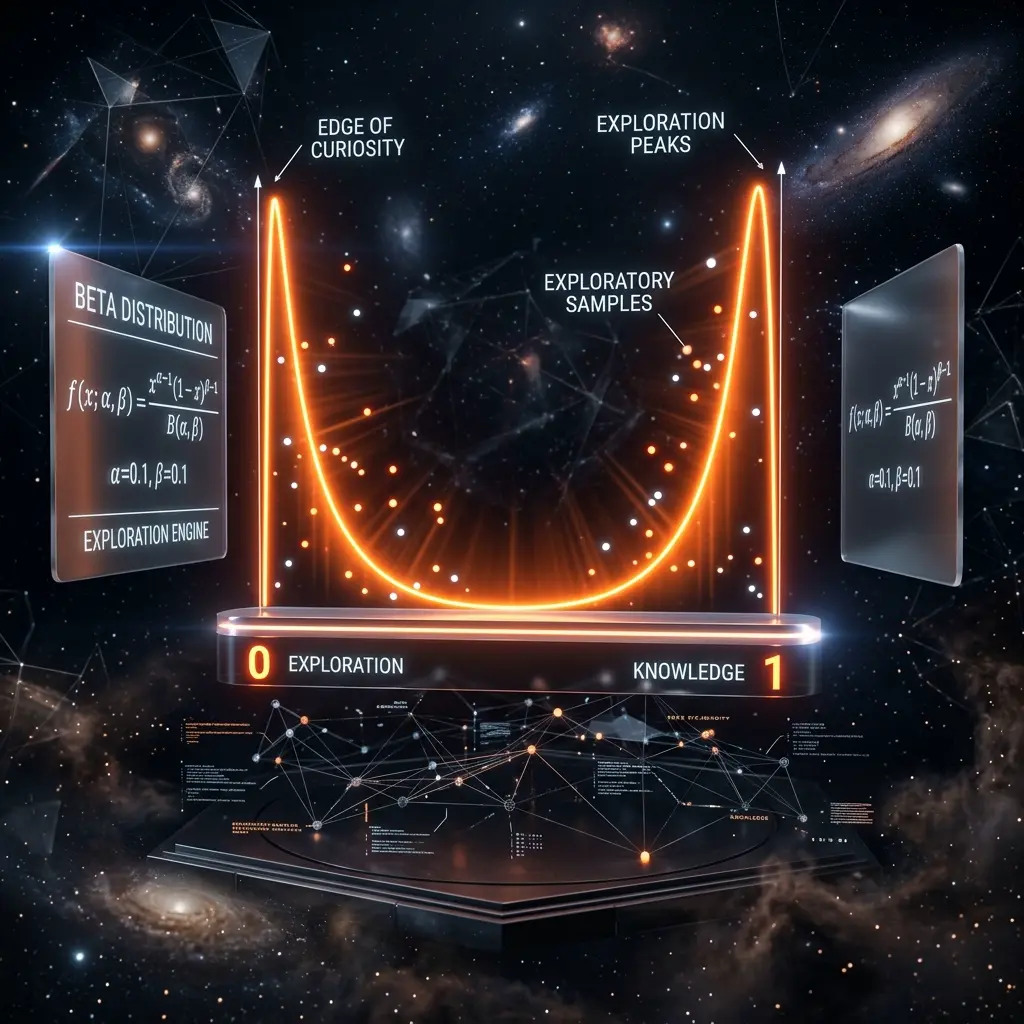
A perfect AI agent shouldn’t just be “obedient.” If it only repeats known paths, it will never evolve in changing environments. Aura’s Curiosity Engine is designed precisely to break the shackles of “empiricism.”
1. Experience Traps and Feedback Collapse
In reinforcement learning, systems easily develop “positive feedback bias”: because path A was successful, they try path A infinitely. Over time, the system severely overfits to path A and loses the ability to perceive better solution B. We call this Feedback Collapse.
2. Beta Distribution Sampling: Mathematical “Thirst for Knowledge”
To quantify “curiosity,” Aura introduces the Beta Distribution $B(\alpha, \beta)$ from statistics.
2.1 Sampling Regulator
Beta distribution is defined on the interval $[0, 1]$. By dynamically adjusting parameters $\alpha$ and $\beta$, we can control the system’s personality:
- Conservative Mode ($\alpha, \beta > 1$): Probability density is concentrated in the middle; the system tends to choose high-confidence traditional paths.
- Curiosity Mode ($\alpha, \beta < 1$): The distribution is U-shaped, and the system samples at the boundaries (0 or 1) with extremely high probability. This means it deliberately chooses “extremely unfamiliar” or “never-before-tried” extreme nodes.
2.2 Entropy-Driven Activation
When Meta detects that the task success rate has stagnated for a long time and the entropy in the knowledge base has decreased, the system automatically lowers $\alpha$ and $\beta$. This “artificial anxiety” forces the ants to leave their comfort zones and explore cold coordinates in the 3D matrix.
3. MMR Algorithm: The Game between Relevance and Diversity
Sampling driven by curiosity is not blindly random. We cooperatively use the MMR (Maximum Marginal Relevance) algorithm:
$$\text{MMR} = \arg\max_{D_i \in R\setminus S} [\lambda \cdot \text{Sim}(D_i, Q) - (1-\lambda) \cdot \max_{D_j \in S} \text{Sim}(D_i, D_j)]$$
It ensures that while searching for “novel knowledge,” the semantic baseline with the current task goal ($Q$) is still maintained. This allows the Agent to “brainstorm” without going off-topic.
4. Conclusion: The Driving Force of Evolution
The curiosity engine gives Aura the ability to “proactively make mistakes.” It is these controlled, small-scale exploration failures that eventually converge into the system’s leapfrog evolution. It transforms the Agent from a passive execution tool into a digital being with an “exploratory spirit.”
Produced by Dark Lattice Architecture Lab.