
Aura 3D Binary Addressing: Absolute Cybernetics under 24-bit Masking
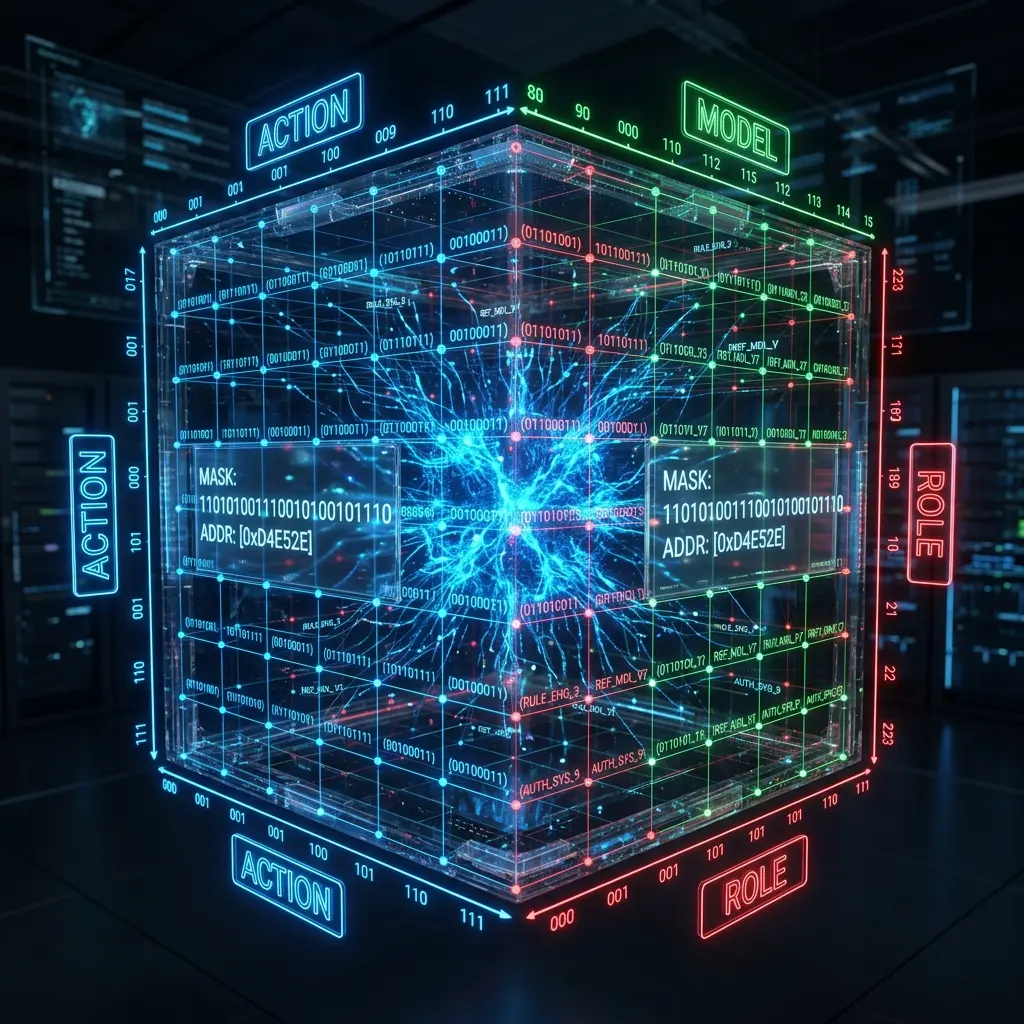
While most Agent frameworks are still parsing cumbersome JSON configurations or string routes, Aura has entered the Binary Addressing Era. We believe that an agent’s decision space should not be a fuzzy semantic collection, but a Geometric Tensor that can be precisely coordinate-mapped.
1. The 24-bit Trinity: Geometricizing Decision Dimensions
We collapse all of the agent’s runtime variables into a single 24-bit composite pointer. This pointer consists of three mutually perpendicular dimensions, defining a 3D cube with 16.77 million potential states:
$$\text{Address} = (\text{Action} \ll 16) \mid (\text{Model} \ll 8) \mid \text{Role}$$
1.1 Action (8-bit): Function Semantics of Atomic Actions
Defines 256 “what to do.” From File:Write to Web:Search, each action corresponds to a WASM module memory entry point. Through the 8-bit mask, the system can instantly index the execution logic, eliminating any overhead of string matching.
1.2 Model (8-bit): Dynamic Routing of Compute Tiers
Defines “who does it.” This is not just a model name, but a Performance/Cost Evaluation Value. 0x01 might represent a local lightning-fast model, while 0xFF represents the most expensive reasoning model. Meta dynamically fills this field based on the task’s “value coefficient,” achieving a real-time optimal cost-performance solution.
1.3 Role (8-bit): Knowledge Background and Personality Bias
Defines “as whom to do it.” This directly affects the weight distribution during RAG retrieval. The same Action, under an Architect role vs. a Security Auditor role, will load entirely different contextual knowledge.
2. Extreme Performance via Memory Locking
In the low-level implementation, Aura uses Rust to build a Direct Mapping Hash Table:
- Zero-Collision Addressing: Since the 24-bit space occupies only about 256MB in modern memory (calculated at 16 bytes per entry), we can perform direct array addressing.
- mlock Protection: The addressing table is locked into physical memory via system calls. This means the Matrix does not need disk access or complex dynamic allocation during jump execution; jump latency is pressed down to the nanosecond level.
3. Design Philosophy: Collapsing Complexity into Bitwise Operations
The essence of this design is “trading space for determinism.”
By pre-computing and mapping complex semantic decisions into a 3D coordinate space, Aura successfully avoids “routing hallucinations” common in the Agent field. In the instructions issued by Meta, there are no fuzzy words like “please help me write code,” only cold, precise, and absolutely unambiguous binary coordinates like 0x0F22A1.
4. Conclusion
3D Binary Addressing is the physical foundation for Aura’s performance as a digital being. It makes an agent’s thinking process not just understandable, but calculable and predictable.
Produced by Dark Lattice Architecture Lab.